<?xml version="1.0" encoding="utf-8"?>

<feed xmlns="http://www.w3.org/2005/Atom">
    <title type="text">citygen</title>
    <subtitle type="html">Procedural City Generation.</subtitle>
    <updated>2010-04-22T18:17:54Z</updated>
    <id>tag:example.org,2003:3</id>
    <link rel="alternate" type="text/html" hreflang="en" href="http://www.citygen.net" />
    <link rel="self" type="application/atom+xml" href="http://www.citygen.net/feeds/atom.xml" />
    <rights>Copyright (c) 2008, gk</rights>

    <generator uri="http://www.citygen.net" version="0.8">
        Bloog for AppEngine
    </generator>

    
    <entry>
        <title>Relief Mapping Buildings</title>
        <link rel="alternate" type="text/html" href="http://www.citygen.net/2008/3/Relief-Mapping-Buildings" />

        <id>http://www.citygen.net/2008/3/Relief-Mapping-Buildings</id>

        <updated>2010-04-22T18:17:54Z</updated>
        <published>2008-03-08T20:40:54Z</published>

        <author>
            <name>gk</name>
            <uri>http://www.citygen.net</uri>
        </author>

        <content type="xhtml" xml:lang="en" xml:base="http://www.citygen.net">
            <div xmlns="http://www.w3.org/1999/xhtml">
                <table style="text-align: center; border: 0pt none;" summary="Texture 
Mapping Techniques" border="0" cellpadding="0" cellspacing="0"><tbody><tr><td colspan="3"><img src="http://citygen.net/files/images/building_relief_small.jpg" /></td>
</tr>
<tr>
<td><em>a: Base Texture</em></td>
<td><em> b: Normal Mapping</em></td>
<td><em>c: Relief Mapping</em></td>
</tr>
</tbody>
</table>
<p>In order to simulate additional geometry, that is not present in the 
basic building meshes generated by citygen, relief mapping is used. 
Normal mapping can be used as a solution to add detail to the shading of
 an object, notice how image <em>b </em>contains shadows and highlights 
for the window portions in contrast to image <em>a</em>. Relief mapping 
provides two major benefits in addition to normal mapping, namely the 
effects of parallax and occlusion, like the similar method of 'Parallax 
Occlusion Mapping'.</p>
<div>
<ul><li><strong>Parallax:</strong> is the effect where the 
apparent position of an object changes with the observation point. This 
is illustrated in the diagram above where the windows on the left 
of building <em>c</em> appear behind the original window opening in 
contract to the other two.</li></ul>
<ul><li><strong>Occlusion:</strong> is the effect where an object is masked,
 hidden or occluded from view by an object that is closer to the 
observation point. This is illustrated on building c where the windows 
are no longer completely visible due to the occlusion provided by the 
walls.</li></ul>
</div>
<p>With these benefits taken into account and by simply observing the 
results of each technique it is clear that relief mapping is a much 
better solution for simulating geometry than standard texturing and 
normal mapping techniques.</p> 
            </div>
        </content>
    </entry>
    
    <entry>
        <title>GDTW Paper</title>
        <link rel="alternate" type="text/html" href="http://www.citygen.net/2007/12/GDTW-Paper" />

        <id>http://www.citygen.net/2007/12/GDTW-Paper</id>

        <updated>2011-02-20T16:15:40Z</updated>
        <published>2007-12-20T14:56:43Z</published>

        <author>
            <name>gk</name>
            <uri>http://www.citygen.net</uri>
        </author>

        <content type="xhtml" xml:lang="en" xml:base="http://www.citygen.net">
            <div xmlns="http://www.w3.org/1999/xhtml">
                <p style="text-align: justify;"><a href="http://www.cms.livjm.ac.uk/GDTW/GDTW2007/" title="GDTW 2007"><img src="/files/images/gdtw07_logo.jpg" alt="GDTW 07 logo" title="GDTW 07 logo" style="float: left;" /></a>I presented a paper at GDTW in Liverpool titled 'Citygen: An Interactive System for Procedural City Generation'. The paper provides an overview of the system describes in some detail the concepts of adaptive roads, city cell extraction, road growth and snapping algorithms. The accompanying presentation illustrates the application of these concepts in the citygen app and includes video capture demonstrations.</p>
<table border="0" width="100%">
<tbody>
<tr>
<td style="text-align: center;"><a href="http://citygen.net//files/CitygenGDTW07Presentation.swf"><img src="/files/images/gdtw07_presentation.jpg" alt="GDTW07 Presentation" title="GDTW07 Presentation" height="137" width="177" /></a></td>
<td style="text-align: center;"><a href="/files/citygen_gdtw07.pdf"><img src="/files/images/gdtw07_paper.gif" alt="GDTW07 Paper" title="GDTW07 Paper" /></a></td>
</tr>
<tr>
<td style="text-align: center;"><a href="http://citygen.net/files/CitygenGDTW07Presentation.swf">Download Presentation</a></td>
<td style="text-align: center;"><a href="http://citygen.net//files/citygen_gdtw07.pdf">Download Paper</a></td>
</tr>
</tbody>
</table>

            </div>
        </content>
    </entry>
    
    <entry>
        <title>Collada Export Complete</title>
        <link rel="alternate" type="text/html" href="http://www.citygen.net/2007/10/Collada-Export-Complete" />

        <id>http://www.citygen.net/2007/10/Collada-Export-Complete</id>

        <updated>2010-04-22T18:20:09Z</updated>
        <published>2007-10-16T10:01:09Z</published>

        <author>
            <name>gk</name>
            <uri>http://www.citygen.net</uri>
        </author>

        <content type="xhtml" xml:lang="en" xml:base="http://www.citygen.net">
            <div xmlns="http://www.w3.org/1999/xhtml">
                <div class="content"><p style="text-align: center;"><img src="http://citygen.net/files/images/collada_ex.jpg" height="202" width="397" /></p>
<p>The <a href="http://www.collada.org/mediawiki/index.php/COLLADA">COLLADA</a>
 format provides a common format to share scene data between tools and 
enable Citygen to be easily integrated into the development pipeline. 
Collada is suppported to some degree in all of the following <a href="http://usa.autodesk.com/adsk/servlet/index?id=5659302&amp;siteID=123112">3ds
 Max</a>, <a href="http://usa.autodesk.com/adsk/servlet/index?siteID=123112&amp;id=7635018">Maya</a>,
 <a href="http://www.blender.org/">Blender</a>, <a href="http://www.righthemisphere.com/products/dexp/">Deep Exploration</a>
 (^shown above), <a href="http://www.newtek.com/lightwave/">Lightwave </a>and
 <a href="http://www.softimage.com/products/xsi/">XSI</a>.<br /> <br /> 
Update: Plugins are available for both 3ds Max and Maya from <a href="http://www.feelingsoftware.com/content/view/16/30/lang,en/">feelingsoftware</a>
 that make importing and exporting Collada documents simple. The builtin
 support of Collada in max and maya is bad so anyone using max or maya 
should download the plugins.</p>
</div> 
            </div>
        </content>
    </entry>
    
    <entry>
        <title>Lot Division</title>
        <link rel="alternate" type="text/html" href="http://www.citygen.net/2007/8/Lot-Division" />

        <id>http://www.citygen.net/2007/8/Lot-Division</id>

        <updated>2012-04-22T20:53:13Z</updated>
        <published>2007-08-21T14:27:58Z</published>

        <author>
            <name>gk</name>
            <uri>http://www.citygen.net</uri>
        </author>

        <content type="xhtml" xml:lang="en" xml:base="http://www.citygen.net">
            <div xmlns="http://www.w3.org/1999/xhtml">
                <p>The lot division algorithm works by subdividing each region using a deviated perpendicular bisector of the longest side. Two or more polygons can result from the operation and subdivision is continued recursively until a target lot size is reached. Lots that do not have direct road access are excluded from the final set.</p>
<p><video src="/static/files/citygen_lots.mp4" style="width: 100%" controls="true" poster="/static/files/citygen_lots.png"></video></p>
<p>Problems were encountered with the realism of the resulting output. The algorithm worked fine for regular square like blocks but when applied to suburban or irregular shapes the resulting lots appeared angular and misaligned. To improve the realism of the output the shape and position of the lots had to be improved. I found that by prioritising subdivision along the road access sides the shapes of the lots became more regular and almost all lots are positioned perpendicular to their access road.</p>
            </div>
        </content>
    </entry>
    
    <entry>
        <title>Another Poster at Siggraph</title>
        <link rel="alternate" type="text/html" href="http://www.citygen.net/2007/8/Another-Poster-at-Siggraph" />

        <id>http://www.citygen.net/2007/8/Another-Poster-at-Siggraph</id>

        <updated>2011-02-16T23:11:21Z</updated>
        <published>2007-08-07T01:20:21Z</published>

        <author>
            <name>gk</name>
            <uri>http://www.citygen.net</uri>
        </author>

        <content type="xhtml" xml:lang="en" xml:base="http://www.citygen.net">
            <div xmlns="http://www.w3.org/1999/xhtml">
                <p style="text-align: justify;"><a href="http://www.siggraph.org/s2007/" title="SIGGRAPH 2007"><img src="/files/images/siggraph07_logo.gif" alt="Siggraph 07 logo" title="Siggraph 07 logo" style="float: left;" /></a>I have another poster at Siggraph this time titled 'Interactive City Generation'. The poster shows some of the work that I have implemented including the new lot division code and road generation. The poster is a little short on detail but it is only an overview. There is also a short section and building screenshot of the Shape Grammar work graham is doing.</p>
<table border="0" width="100%">
<tbody>
<tr>
<td style="text-align: center;"><a href="/files/citygen_siggraph07.pdf"><img src="/files/images/sig07_poster.gif" alt="Siggraph07 Poster" title="Siggraph07 Poster" height="137" width="177" /></a></td>
<td style="text-align: center;"><a href="/files/citygen_abstract_siggraph07.pdf"><img src="/files/images/sig07_abstract.jpg" alt="Siggraph 07 Poster Abstract" title="Siggraph07 Poster Abstract" /></a></td>
</tr>
<tr>
<td style="text-align: center;"><a href="/files/citygen_siggraph07.pdf">Download Poster</a></td>
<td style="text-align: center;"><a href="/files/citygen_abstract_siggraph07.pdf">Download Abstract (incl references)</a></td>
</tr>
</tbody>
</table>
<p style="text-align: justify;">The application is progressing and soon I'll put up a version to try out after I get some of the reliability and thread issues resolved.</p>

            </div>
        </content>
    </entry>
    
    <entry>
        <title>Citygen Preview</title>
        <link rel="alternate" type="text/html" href="http://www.citygen.net/2007/5/Citygen-Preview" />

        <id>http://www.citygen.net/2007/5/Citygen-Preview</id>

        <updated>2012-04-22T22:31:53Z</updated>
        <published>2007-05-22T11:30:44Z</published>

        <author>
            <name>gk</name>
            <uri>http://www.citygen.net</uri>
        </author>

        <content type="xhtml" xml:lang="en" xml:base="http://www.citygen.net">
            <div xmlns="http://www.w3.org/1999/xhtml">
                <p>The citygen application is usable at the moment but I'm only beginning to work with it so much better results should be possible in a few weeks.</p>
<p><iframe src="http://www.youtube.com/embed/CUSsyt-ixa0" frameborder="0" width="435" height="350"></iframe></p>
<p>The primary road network roads are terrain adaptive and plotted to optimum routes around hills, etc. Within enclosed regions of the primary road network, secondary roads are generated using a parametric organic growth algorithm. I've submitted an abstract for a short paper with a little more detail hope to get that up soon. Let me know what you think of the app.</p>
            </div>
        </content>
    </entry>
    
    <entry>
        <title>Procedural City Generation Survey</title>
        <link rel="alternate" type="text/html" href="http://www.citygen.net/2006/11/Procedural-City-Generation-Survey" />

        <id>http://www.citygen.net/2006/11/Procedural-City-Generation-Survey</id>

        <updated>2012-04-22T20:38:38Z</updated>
        <published>2006-11-27T12:56:02Z</published>

        <author>
            <name>gk</name>
            <uri>http://www.citygen.net</uri>
        </author>

        <content type="xhtml" xml:lang="en" xml:base="http://www.citygen.net">
            <div xmlns="http://www.w3.org/1999/xhtml">
                <p>I have written a survey paper for publication in the ITB Journal that outlines the existing approaches to procedural city generation and provides a discussion into the merits of each approach. All references are included so it should be a useful paper to begin research into procedural city generation.</p>
<table border="0">
<tbody>
<tr>
<td><a href="http://citygen.net/files/images/Procedural_City_Generation_Survey.pdf"><img src="../../files/images/survey_thumbnail.gif" alt="A Survey of Procedural Techniques for City Generation" width="122" height="147" /></a></td>
<td>
<ul>
<li>Introduction into Procedural Techniques</li>
<li>Grid Based Layout</li>
<li>L-systems</li>
<li>Agent Based Simulation</li>
<li>Voronoi and Template Based techniques</li>
<li>Shape Grammars</li>
</ul>
</td>
</tr>
</tbody>
</table>
<p><a href="http://citygen.net/files/images/Procedural_City_Generation_Survey.pdf">Download Survey Paper</a></p>
<p style="clear: both; margin-top: 5px;">Please read the paper and feel free to let me know your thoughts on it, has anything been left out or do you feel that there are any errors in the paper.</p>
<p>Update: The paper has been published in the <a href="http://www.itb.ie/site/researchinnovation/itbjournal/ITB-Journal-December-2006.pdf">ITB Journal Issue 14</a> which can be found <a href="http://www.itb.ie/site/researchinnovation/itbjournal.htm">here</a>.</p>
            </div>
        </content>
    </entry>
    
    <entry>
        <title>Poster at Siggraph</title>
        <link rel="alternate" type="text/html" href="http://www.citygen.net/2006/8/Poster-at-Siggraph" />

        <id>http://www.citygen.net/2006/8/Poster-at-Siggraph</id>

        <updated>2011-02-16T23:18:38Z</updated>
        <published>2006-08-02T13:25:38Z</published>

        <author>
            <name>gk</name>
            <uri>http://www.citygen.net</uri>
        </author>

        <content type="xhtml" xml:lang="en" xml:base="http://www.citygen.net">
            <div xmlns="http://www.w3.org/1999/xhtml">
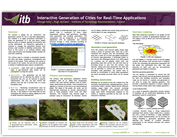
                <p style="text-align: justify;"><a href="http://www.siggraph.org/s2006/" title="SIGGRAPH 2006"><img src="/files/S2006_PC_leftRGB.jpg" alt="Siggraph 06 logo" title="Siggraph 06 logo" style="float: left;" /></a>I have a poster at Siggraph  titled 'Interactive Generation of Cities for Real-Time Applications'. The poster illustrates our current research in city generation, we provide an outline of a solution using  a combination of techniques including templates and L-systems. Road pattern templates are applied in the form of an editable graph and growth algorithms like L-systems are used to create a complete road network.</p>
<table border="0" width="100%">
<tbody>
<tr>
<td style="text-align: center;"><a href="/files/citygen_siggraph06.pdf"><img src="/files/images/sig06_poster.gif" alt="Siggraph06 Poster" title="Siggraph06 Poster" height="137" width="177" /></a></td>
<td style="text-align: center;"><a href="/files/citygen_abstract_siggraph06.pdf"><img src="/files/images/sig06_abstract.gif" alt="Siggraph 06 Poster Abstract" title="Siggraph06 Poster Abstract" /></a></td>
</tr>
<tr>
<td style="text-align: center;"><a href="/files/citygen_siggraph06.pdf">Download Poster</a></td>
<td style="text-align: center;"><a href="/files/citygen_abstract_siggraph06.pdf">Download Abstract (incl references)</a></td>
</tr>
</tbody>
</table>
<p style="text-align: justify;">The design and associated application is still in the early stages of it evolution but shows the direction of our research.</p>
            </div>
        </content>
    </entry>
    
    <entry>
        <title>Extract diagrams from pdf - pdf2svg</title>
        <link rel="alternate" type="text/html" href="http://www.citygen.net/2006/7/Extract-diagrams-from-pdf-pdf2svg" />

        <id>http://www.citygen.net/2006/7/Extract-diagrams-from-pdf-pdf2svg</id>

        <updated>2011-02-16T23:20:32Z</updated>
        <published>2006-07-18T23:03:32Z</published>

        <author>
            <name>gk</name>
            <uri>http://www.citygen.net</uri>
        </author>

        <content type="xhtml" xml:lang="en" xml:base="http://www.citygen.net">
            <div xmlns="http://www.w3.org/1999/xhtml">
                <p>PDFs are the primary format for research papers and are used for many other publications as well. It is possible to get diagrams in a friendly usable format with the aid of a few tools</p>
<p>Why bother? Its easy to get a screenshot of a pdf diagram but there are problems.</p>
<ol>
<li>Resampling bitmaps in diagrams is very lossy and file size bloats considerably when over sampling.</li>
<li>Images do not scale gracefully or provide the same detail and clarity present in the vector diagram of pdfs.</li>
<li>Using images in place of vector diagrams bloats file size.</li>
</ol>
<p>To extract the full details of diagrams in pdf files it is important to convert them into an equivalent format that can maintain the vector and bitmap information. An obvious choice for this is the open SVG (Simple Vector Graphics) format that also provides a wide range of tools and is designed to work on the web.</p>
<p>Initially a fine service was available <a href="http://freesvg.texterity.com/">here</a> that converted entire pdfs on demand, unfortunetly at time of writing this service is not available anymore.</p>
<p>The tools required to extract pdf diagrams to SVG on your machine are:</p>
<ol>
<li><a href="http://www.pstoedit.net/pstoedit" title="pstoedit">pstoedit</a></li>
<li><a href="http://www.cs.wisc.edu/%7Eghost/doc/AFPL/get853.htm">ghostscript - gs<br />
</a></li>
<li><a href="http://www.inkscape.org/">Inkscape</a> to view and edit *.svg files.</li>
</ol>
<p>The commands I use are:</p>
<p>pstoedit -f svg input_file.pdf output_file.svg <br />
pstoedit -f svg -page 1 input_file.pdf output_file.svg<br />
pstoedit -f plot-svg -page 1 input_file.pdf output_file.svg</p>
<p>Note: the -f switch specifies the output format, 'svg' extracts all bitmaps but has some limitations - mainly messing the colours, 'plot-svg' works well but doesn't get all the images.</p>
<p>With diagrams in lovely SVG format you can then import them into your word processor for small files and high detail. For <a href="http://www.openoffice.org">openoffice</a> I use this <a href="http://www.ipd.uni-karlsruhe.de/%7Ehauma/svg-import/">SVG import plugin</a>.</p>
            </div>
        </content>
    </entry>
    
    <entry>
        <title>wxWidgets, wxAui &amp; Ogre3D friends with a native cursor.</title>
        <link rel="alternate" type="text/html" href="http://www.citygen.net/2006/5/wxWidgets-wxAui-Ogre3D-friends-with-a-native-cursor" />

        <id>http://www.citygen.net/2006/5/wxWidgets-wxAui-Ogre3D-friends-with-a-native-cursor</id>

        <updated>2011-02-16T23:23:05Z</updated>
        <published>2006-05-04T15:11:05Z</published>

        <author>
            <name>gk</name>
            <uri>http://www.citygen.net</uri>
        </author>

        <content type="xhtml" xml:lang="en" xml:base="http://www.citygen.net">
            <div xmlns="http://www.w3.org/1999/xhtml">
                <p>I've found a solution to using a native mouse cursor for ogre. I'm going to use wxWidgets &amp; Ogre together by passing a pointer to the wxWindow into the createRenderWindow as a param titled "externalWindowHandle".</p>
<p>This approach is available as a non working sample from the source based release of ogre. Also more recently used in the <a href="http://www.ogre3d.org/phpBB2/viewtopic.php?t=12699&amp;start=0&amp;postdays=0&amp;postorder=asc&amp;highlight=Mage">Mage</a> project to create a visual scene editor for Ogre.</p>
<p>I initally used the main window hWnd to create the ogre render window but found that the screen coordinates were offset by the toolbar and could not be corrected. So instead I opted to use a nice window manager <a href="http://www.kirix.com/en/community/opensource/wxaui/about_wxaui.html" title="wxAui">wxAui</a> that provide dockable draggable windows elements like an IDE.<img src="/files/CityGen%20wxWindow%20sc1.png" alt="Screenshot" title="Screenshot" height="352" width="361" /></p>
<p>Here is a screenshot of my current network editor the toolbar is not wired but picking works allowing the adding and moving of nodes.</p>

            </div>
        </content>
    </entry>
    

</feed>